
The Half-Payment Budget Method: How to Never Stress Over Rent Day Again
Learn how the half-payment budget method splits your largest monthly bills across biweekly paychecks so rent day never empties your bank account again.
Guilt-Free Spending Allowance
Calculate your exact biweekly spending cash after automating half-payments for fixed bills.
If you get paid every two weeks, you know the dreaded first paycheck of the month. That single direct deposit lands in your account on a Friday morning. By Friday afternoon, rent or your mortgage takes almost all of it. You spend the next thirteen days eating peanut butter sandwiches, hoping your car does not make any weird rattling noises before your next paycheck arrives.
Then the second paycheck arrives two weeks later. Suddenly you feel flush with cash. You pay a couple of small utility bills, buy groceries, and feel like you have plenty of spending money.
This financial roller coaster is exhausting. It makes you feel broke half the time and artificially rich the other half. Yet your total annual income never changed.
The root problem is simple. Most household bills operate on a monthly schedule. Landlords, mortgage lenders, utility companies, and car loan servicers expect one large check every thirty days. But your employer pays you on a biweekly schedule twenty six times a year. Forcing a biweekly income stream into a monthly billing cycle creates an awkward cash flow mismatch.
The half payment budget method fixes this exact problem. It levels out your spending, eliminates rent day anxiety, and turns your calendar into a reliable wealth building machine.
What Is the Half-Payment Budget Method?
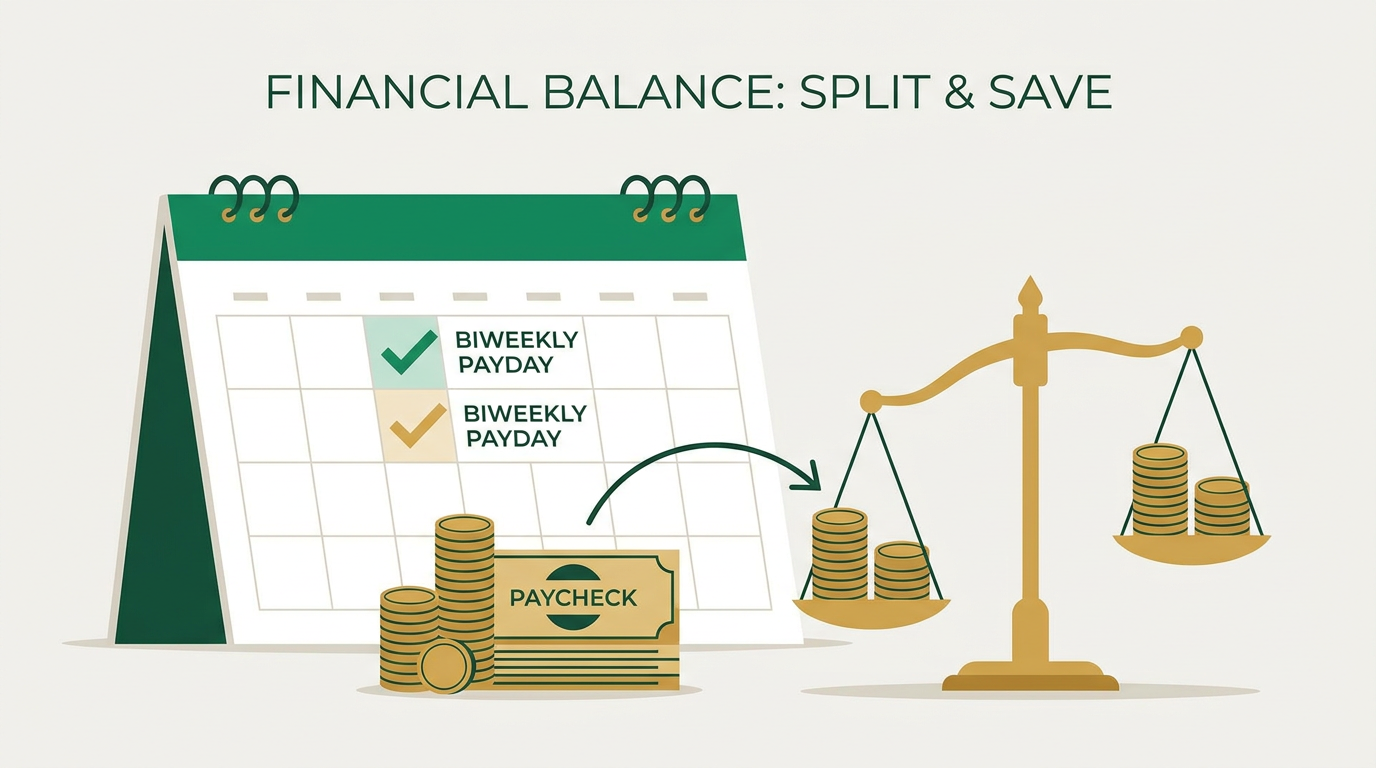
The concept behind the half payment method is beautifully simple. Instead of paying each major bill in one giant lump sum from a single paycheck, you divide every fixed monthly bill in half. You set aside that exact half from each biweekly paycheck.
When rent is due on the first of the month, the money is already waiting in your account. Half of it came from your previous paycheck, and half came from the paycheck before that.
No single paycheck bears the burden of your largest expenses. Every payday feels identical. You set aside the exact same amount for bills, put the exact same amount into savings, and keep the exact same amount for weekly groceries and fun money.
Here is what changes when you switch from the traditional lump sum approach to the half payment system:
| Feature | Traditional Monthly Budget | Half-Payment Budget Method |
|---|---|---|
| Paycheck #1 Stress | Very high because rent consumes 70% of pay | Zero because only half of rent is reserved |
| Paycheck #2 Reality | Feels like excess surplus cash | Balanced and identical to Paycheck #1 |
| Overdraft Risk | Peaks during the first week of every month | Minimal because cash reserves stay level |
| Cash Flow Rhythm | Feast or famine every fourteen days | Steady and completely predictable |
| Annual Bonus Months | Often swallowed by random catch-up spending | Two full paychecks saved as pure surplus |
Step 1: List Your Fixed Monthly Obligations
To build your half payment plan, gather all recurring bills that stay the same or relatively predictable each month. Do not include flexible items like dining out or clothing shopping yet. Focus solely on mandatory monthly commitments:
- Rent or mortgage payment
- Car loan or lease payments
- Student loans and personal loans
- Auto, home, or renters insurance
- Internet and home utility averages
- Minimum debt obligations
Write down the exact monthly total for each expense. Suppose your numbers look like this typical household profile:
- Rent: $1,600
- Car payment: $380
- Auto insurance: $140
- Internet service: $80
- Electric and gas average: $160
- Student loan payment: $240
Your total monthly fixed bills equal $2,600.
Step 2: Divide Every Fixed Expense by Two
Take your total fixed commitment of $2,600 and divide it by two. That gives you $1,300.
That means every time you receive a biweekly paycheck, exactly $1,300 belongs to your bills holding account.
| Monthly Bill | Full Monthly Cost | Half-Payment Per Paycheck |
|---|---|---|
| Rent or Mortgage | $1,600 | $800 |
| Car Payment | $380 | $190 |
| Auto Insurance | $140 | $70 |
| Home Internet | $80 | $40 |
| Utilities Average | $160 | $80 |
| Student Loan | $240 | $120 |
| Total Set Aside | $2,600 | $1,300 |
If your take home pay is $2,100 every two weeks, you know with absolute certainty that $1,300 goes to fixed bills. That leaves you with $800 from each paycheck for groceries, gas, emergency savings, and guilt free spending.
You never have to wonder if you can afford to buy groceries during the first week of the month. Your disposable income remains exactly $800 every single payday.
Step 3: Set Up a Dedicated Bills Checking Account
The secret to making this method work without headaches is physical separation. Trying to keep bill money and daily spending money inside the same checking account is a recipe for accidental spending.
Open a secondary checking account with your bank. Label it Bills Checking. Keep your existing account as Spending Checking.
Here is how the automated money flow works:
- Direct Deposit Split: If your employer payroll portal allows split direct deposits, send $1,300 straight into Bills Checking and the remaining $800 into Spending Checking.
- Automated Transfer: If your payroll cannot split deposits, set an automatic recurring transfer for the day after payday to move $1,300 from your primary account to Bills Checking.
- Autopay All Fixed Bills: Point all automatic bill drafts, rent portals, and credit card payments to draw directly from Bills Checking.
Once this system is active, you never touch Bills Checking with your debit card. You only carry the debit card linked to Spending Checking. Bills get paid automatically in the background, fully funded two weeks before they are even due.
Step 4: The Startup Buffer (How to Begin Without Falling Behind)
The biggest hurdle beginners face is the transition phase. If rent is due in five days and you only have half the money set aside, you cannot immediately switch without falling short.
You need a small one time buffer to get the system rolling. You have three simple options to create this starting buffer:
- Use a Portion of Your Emergency Savings: Transfer half of one month of bills (in our example, $1,300) into Bills Checking as your permanent baseline cushion.
- Phase In One Bill at a Time: Start by splitting smaller bills like car insurance and internet. Once those run smoothly, split your car payment. Within two or three months, accumulate enough cushion to split your rent.
- Launch During a Three Payday Month: Most biweekly workers experience two months each year with three paychecks instead of two. Using that third paycheck to establish your permanent bills buffer is the easiest, stress free path.
The Magic of the Two Three-Payday Months
Most people believe a biweekly schedule means two paychecks every month, which would equal twenty four paychecks a year. But a year has fifty two weeks. Fifty two divided by two is twenty six paychecks.
That means in two glorious months every year, you will receive three paychecks instead of two.
In a traditional budget, people often waste these third paychecks because they lack a clear system. They treat the money as unexpected cash and spend it on random shopping or dining.
Under the half payment method, your bills are completely paid for using two half payments per month. That means during a three payday month, your third paycheck has zero fixed bill obligations attached to it.
The entire third paycheck is pure surplus cash.
If your biweekly take home pay is $2,100, you receive an extra $4,200 of clean, unencumbered cash every single year. You can send that entire sum toward high interest credit card debt, invest it into an index fund, or fund a dream vacation without touching your everyday living budget.
Common Mistakes to Avoid
While the half payment method is simple, watch out for these three common traps:
Stealing From the Bills Account
When an unexpected expense pops up on a Friday night, it is tempting to pull fifty dollars out of your Bills Checking account. Never do this. Treat Bills Checking as untouchable money that belongs to your future self. If you need money for unexpected repairs, use a dedicated emergency fund instead.
Forgetting About Fluctuating Utilities
Electric bills rise in the summer when the air conditioning runs and spike in the winter when the heat kicks on. Do not budget for your lowest electric bill. Look at your past twelve months of statements, find the highest bill, and divide that number in half. Any surplus that accumulates during mild spring and autumn months will cushion the peak summer bills.
Keeping Only One Account
Trying to mentally track which dollars in your checking account belong to rent and which belong to Friday dinner will cause mental fatigue. Open the second checking account. The psychological peace of mind that comes from opening your banking app and seeing your rent fully funded is worth the ten minutes it takes to open a sub account.
Putting It Into Practice Today
Getting started does not require complicated spreadsheets or paid financial software. Take a piece of paper right now. Write down your fixed monthly bills, divide the total sum by two, and open a dedicated bills account.
Once your bills run on autopilot, payday stops being a day of bill juggling stress. It becomes what it was always meant to be: a steady, dependable foundation for building lasting financial peace.
Written by EasyBudget Team
Fact-Checked • 2026 EditionOur editorial team develops free, privacy-first personal finance calculators and independent money management guides. We cross-reference all math against federal savings guidelines and macroeconomic benchmarks.